
Ice Age Migration
Experience the frozen plains of Europe during the last ice age, alongside Neanderthals and megafauna.
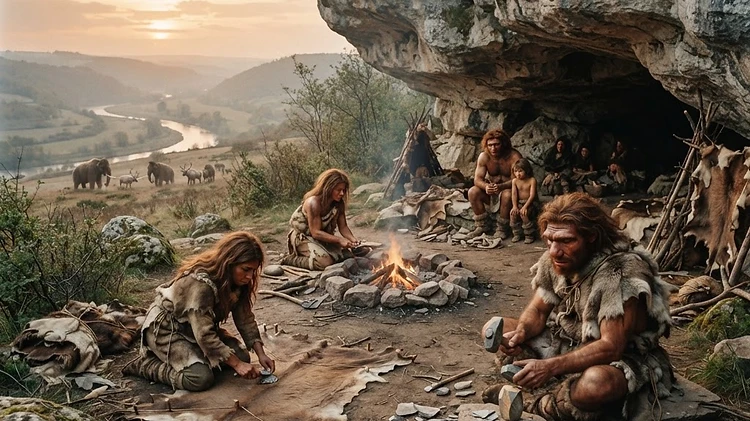
The Age of the Neanderthal
Southern France
A frozen limestone wilderness where the last masters of the Mousterian endure the onset of the Würm glaciation.
The Scene
In 50,000 BCE, Southern France is a realm of stark beauty and brutal environmental pressure. The landscape is dominated by the 'mammoth steppe,' a vast, treeless expanse of hardy grasses, mosses, and lichens that stretches across the European continent. The climate is in the grip of the Last Glacial Period, specifically the Würm glaciation, which has locked much of the northern hemisphere in ice and turned the Dordogne and Provence regions into a subarctic tundra. The valleys of the Vézère and Dordogne rivers serve as vital migratory corridors for massive herds of reindeer, steppe bison, and woolly mammoths. The inhabitants are not modern humans, but Neanderthals (Homo neanderthalensis), a highly adapted and intelligent species perfectly suited for this cold world. They live in small, nomadic kin groups, seeking shelter in the numerous limestone caves and rock shelters (abris) that honeycomb the river cliffs. These sites are more than just homes; they are centers of complex social life, tool production, and perhaps early spiritual expression. The air is crisp, biting, and filled with the scent of woodsmoke and the distant bellows of megafauna, while the horizon is framed by the massive, ice-capped peaks of the Pyrenees to the south.
Subarctic and arid. The region experiences long, brutal winters with temperatures frequently dropping well below -20°C. Summers are short and cool, rarely exceeding 15°C. The air is dry, and high winds often sweep across the open steppe, kicking up dust and loess.
A rugged landscape of limestone plateaus (causses) and deep, winding river valleys. Due to the massive amount of water locked in glaciers, the sea level is approximately 80 to 100 meters lower than today, meaning the Mediterranean coast is dozens of miles further south, exposing a broad coastal plain.
Mousterian lithic technology, characterized by the Levallois flint-knapping technique to produce sharp, standardized flakes. Tools include side-scrapers (racloirs), notched tools (denticulates), and triangular points for spears. They utilize fire-starting kits (pyrite and flint), mineral pigments (ochre and manganese dioxide) for body decoration, and heavy wooden thrusting spears. There is no evidence of sewing needles, pottery, or the bow and arrow.
Daily life is a constant cycle of seasonal movement and resource management. In the summer, groups follow the reindeer migrations, setting up temporary camps near river crossings. Men and women collaborate in high-stakes hunts, using heavy thrusting spears to take down bison or horses. The butchery is a communal event, with every part of the animal used: meat for protein, marrow for fat, hides for clothing, and bone for fuel or simple tools. Evenings are spent around the hearth, the social heart of the group, where stone tools are knapped and hides are painstakingly scraped clean of fat using flint scrapers to prevent rot. Social bonds are maintained through grooming, storytelling, and the sharing of medicinal herbs like yarrow and chamomile.
Key Events
Notable Figures
Fascinating Facts
Journey Live Chat
Join the journey to chat with the crew.