
Glory of Ancient Athens
Walk the streets of classical Athens during its golden age of philosophy and democracy.
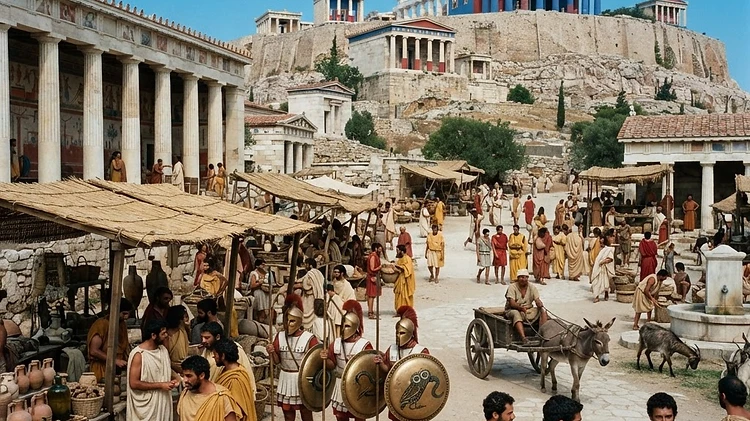
The Golden Age of Pericles and the Shadow of War
Athens, Greece
Experience the pinnacle of Classical Athens as it teeters between unprecedented cultural brilliance and the grim realities of the Peloponnesian War.
The Scene
In 430 BCE, Athens is a city of startling contrasts. From the heights of the Acropolis, the newly completed Parthenon gleams with fresh Pentelic marble and vibrant polychrome paint, symbolizing the height of Athenian imperial power and religious devotion. Below, the Agora is the city's beating heart—a chaotic, sun-drenched marketplace where the air is thick with the scent of roasting meat, olive oil, and the pungent aroma of dried fish. Merchants from across the Mediterranean hawk their wares under the shade of colonnaded stoas, while citizens gather to debate the latest decrees from the Pnyx, the meeting place of the world's first democracy. However, the atmosphere is heavy with tension. The Peloponnesian War against Sparta has just begun, and the city is overcrowded with refugees from the Attic countryside seeking safety behind the Long Walls. To make matters worse, a mysterious and devastating plague has just entered the city via the port of Piraeus. Despite the looming threat, the intellectual and artistic life of the city remains feverish; philosophers like Socrates challenge traditional wisdom in the streets, and the theaters are preparing for the premiere of revolutionary tragedies. It is a moment of extreme human achievement shadowed by the fragility of life.
The climate is typically Mediterranean, featuring hot, dry summers and mild, rainy winters. In 430 BCE, the summer heat is intense, exacerbating the unsanitary conditions caused by overcrowding due to the war, which contributes to the rapid spread of the plague.
Athens is situated on the plain of Attica, surrounded by four mountains: Aegaleo, Parnes, Pentelicus, and Hymettus. The city is dominated by the Acropolis, a flat-topped limestone rock. To the south lies the Saronic Gulf, connected to the city by the 'Long Walls,' which ensure safe passage to the vital port of Piraeus.
Athenians possess advanced stone-masonry techniques, using iron tools and sophisticated cranes (the 'geranos') to lift massive marble blocks. Maritime technology is centered on the trireme—a fast, maneuverable warship with three banks of oars. They also use the 'clepsydra' (water clock) for timing speeches in law courts and have a deep understanding of hydraulic engineering for city fountains.
Daily life revolves around the public sphere for men and the private 'oikos' (household) for women. Athenian men spend their mornings in the Agora or at the gymnasia, engaging in physical training and political discourse. Slaves perform much of the manual labor, from domestic chores to the grueling work in the silver mines of Laurium. Women, particularly of the upper class, remain largely indoors, managing the household, spinning wool, and weaving textiles. In the evenings, wealthy men attend 'symposia'—drinking parties where poetry, music, and philosophy are shared alongside wine diluted with water.
Key Events
Notable Figures
Fascinating Facts
Journey Live Chat
Join the journey to chat with the crew.